

The State of California has been working on regulations to protect property from wildfires, particularly concentrating on occupied structures within Very High Fire Hazard Severity Zones (VHFHSZ) as determined by the state fire marshal. There are a significant number of properties within our San Fernando Valley Audubon Society territory which will be affected, potentially resulting in loss of tree canopy and habitat. Workshops of the California Board of Forestry Zone Zero Committee (the Committee) have been ongoing since March 2025 – mostly in Sacramento and often contentious.
To be clear, many of the proposals are universally acceptable. These include a prohibition on having readily combustible materials adjacent to a residence including firewood, dead vegetation, combustible mulch, wooden fences and gates. Roofs and gutters should be clear of debris. Further everyone supports home-hardening measures and in this author’s opinion these rules and recommendations should be enacted now. The point of contention involves healthy and hydrated vegetation including trees, shrubs, ground covers and other plants within 5 feet of structures. This becomes very significant in densely-populated areas of our cities where close building spacing could result in a requirement to remove virtually all vegetation, including shrubs and trees which provide cooling and habitat.
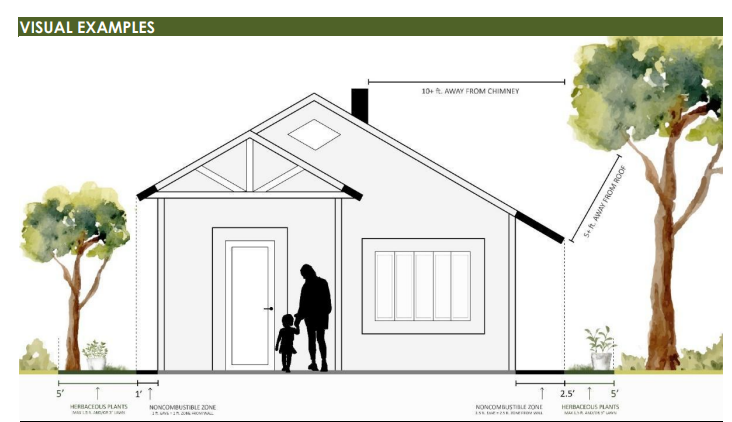
The Committee met in Calabasas on April 23, 2026, with the meeting consisting of presentations and panel discussions following the release of the latest summary and draft rule text. The significant change in this proposal is it eliminates the alternative options in the prior proposal. To briefly summarize the current draft, the state-wide requirement would be to eliminate all vegetation (not including trees) within the greater of 1’ or the eve overhang, 2’ from windows, doors or vents and 5’ from a deck, stairs, or pergola. The remaining area out to 5’ could be planted only with less than 3” tall ground cover or non-woody plants up 18” in height in clumps.Tree branches would need to be 10’ away from chimneys and stovepipe outlets, with branches trimmed 5’ away from roofs and 1’ from walls, and lower branches trimmed to the greater of 6’ or ⅓ the tree height. Rules would apply to all new construction and be phased in for existing structures over 3 to 5 years.
It is obvious from these requirements that a lot of vegetation, shade, and habitat will be lost in our urban residential areas in the VHFHSZ . Scientific integrity and local consultation appear to be secondary to speed in getting rules codified, and we fear that this one-size-fits-all approach to defining defensible space will cause irreparable harm in our region. Further, there is a risk of backlash to our relatively new Very High Fire Hazard Severity Zone maps combined with new regulations. Consider Oregon’s repeal of its fire mapping and related regulations in 2025, with all compliance now being locally directed. The very readable Washington Surfside News May 1, 2026 article “When Fire Risk Policy Goes Too Far: Why Wildfire Maps Were Withdrawn and What it means for Insurance and Property Values” distills the logical conclusion to this: “Wildfire policy must be precise, science-based, and economically balanced—or it risks doing more harm than good “.
Comments may still be made to the Board of Forestry Zone Zero Committee at PublicComments@bof.ca.gov. There are peer-reviewed studies coming out that should be considered in any vegetation-related policy decisions. Let’s not enact rules that are ill founded, premature, and may have irreversible consequences. Further – why not codify items there is consensus on and get started?
SFV Audubon supports options in the October 2025 draft regulations. Specifically Option 4 for vegetation and Option 2 for trees. With respect to vegetation, Option 4 states: “No landscaping materials that are likely to be ignited by embers are permitted within Zone 0. This includes, but is not limited to dead or dying plants, fallen leaves and tree needles, weeds, and combustible mulches including bark and woodchips”. With respect to trees, Option 2 states: “Trees within Zone 0 shall be maintained so that there are no dead or dying branches. All live tree branches shall be maintained ten feet (10’) away from chimneys and stovepipe outlets”.
Posted by Pat Bates, Conservation Committee Co-Chair

